
Container freight rates trends

The spot freight rates for containers from Asia to Europe and from Asia to the United States fell further from record highs last week. However, it is expected to remain high for a period of time.

Container freight rates have fallen sharply for the first time since the beginning of the epidemic, but are expected to remain high

There has been a sharp drop during the Chinese Lunar New Year holiday, but the rate is expected to remain high

Jeremy Nixon, CEO of Japanese liner company Ocean Network Express (ONE), believes that the freight market will not stabilize before the middle of this year.

Container freight rates have fallen sharply for the first time since the beginning of the epidemic, but are expected to remain high

The Lowe's Daily said that in the absence of a sharp decline in traditional freight volumes after the Chinese New Year, the spot freight rates for Asia-Europe and Trans-Pacific trade are still at historical highs; the spot exchange rate flexibility during the Spring Festival shows that the factors that support price increases are still Need to be alleviated. Cargo backlogs, port congestion, equipment shortages and continued high throughput mean shippers are still being charged premiums on the main trade routes.

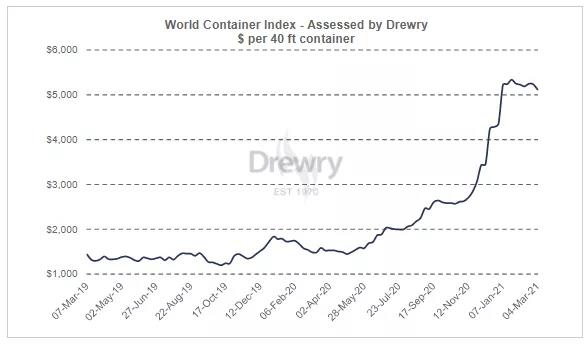
The Drewry Composite Index shows that although it has fallen 2.2% in the past week, it is still 232.6% higher than a year ago. The year-to-date WCI average composite index assessed by Drewry is US$5,231 per 40-foot container, which is US$3539 higher than the five-year average of US$1,692 per 40-foot container.
Container freight rates have fallen sharply for the first time since the beginning of the epidemic, but are expected to remain high

The Drewry Composite Container Index fell 2.2% (US$117) to US$5121.04 per 40-foot container.

The freight from Shanghai to Rotterdam dropped by US$286, reaching US$8188/FEU;

The freight from Shanghai to Los Angeles dropped by 130 USD, reaching 4,261 USD/FEU;

The freight rate of the 40-foot container from Shanghai to Genoa fell by US$106 to US$8,505;

The freight from Shanghai to New York rose by 23 dollars to reach 6,651 dollars/FEU.

Drewry expects rates to stabilize relatively this week.

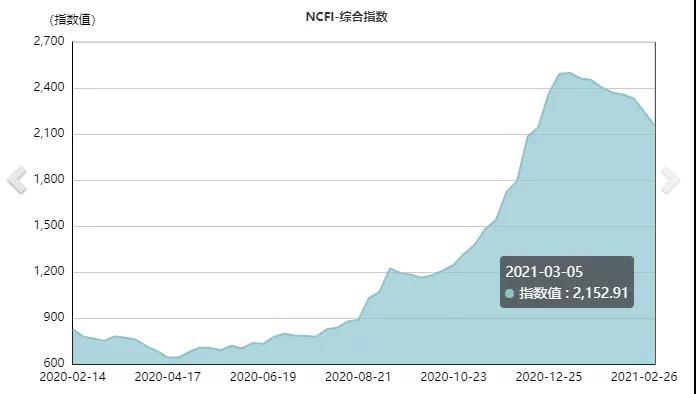
The Ningbo Export Container Freight Index (NCFI) released by the Ningbo Shipping Exchange closed at 2152.91 points, down 4.1% from 2245.32 points last week. Among the 21 routes, the freight index of 5 routes increased, and the freight index of 16 routes decreased. Among the major ports along the "Maritime Silk Road", the freight index of 17 ports fell.

The freight rate of the European-German route dropped as a whole, 3.9% lower than the previous week's European route; the eastern route dropped 4.2%; and the western route dropped 4.9%. While the North American route remained high, the US East route rose 2.5% from last week; the US West route rose 0.2% from last week.
Container freight rates have fallen sharply for the first time since the beginning of the epidemic, but are expected to remain high

European-German route: In view of the fact that the transportation demand is still recovering after the holiday, the goods hoarded before the holiday have basically been shipped, and the booking price of the European-German route has dropped overall. According to Freightos' recent Baltic Index (FBX), the price of 40-foot containers from Asia to Northern Europe fell 4% a week to US$8004; according to FBX data, in the Far East to Europe transaction, the spot freight rate was as high as US$8,306. /FEU, but fell by US$432 over the weekend to US$7,874/FEU (daily index).

Container freight rates have fallen sharply for the first time since the beginning of the epidemic, but are expected to remain high

Container freight rates have fallen sharply for the first time since the beginning of the epidemic, but are expected to remain high

But for Mediterranean ports , the average price dropped by only US$37 last week to US$7,926 per 40 feet.

Container freight rates have fallen sharply for the first time since the beginning of the epidemic, but are expected to remain high


Container freight rates have fallen sharply for the first time since the beginning of the epidemic, but are expected to remain high

Moreover, many shippers are still obliged to pay additional fees to ensure the availability of containers, and for British ports, a "port fee" of US$2,000 is usually added. A year ago, the FBX index showed that the freight rates per 40 feet in the Nordic and Mediterranean regions were US$1,533 and US$2,130 respectively.

Lory Cheung, an overseas marketing expert at China-based MRF International Forwarding, said that shipping companies must “do everything they can to seize every opportunity” because the shipping market will eventually return to normal. He pointed out: "At present, carriers seem to be more willing to sign long-term contracts with BCO rather than freight forwarders," which shows that shipping companies are working hard to lock the contract price at the highest possible level to avoid the impact of spot market fluctuations.

Container freight rates have fallen sharply for the first time since the beginning of the epidemic, but are expected to remain high

In fact, the high inflation rate in current transactions is forcing shippers to cancel orders for low-value products. A British non-vessel carrier (NVOCC) stated that he has noticed that a garden furniture importer’s bookings from China have dropped by a third this year.

North American routes: The market's freight volume has recovered faster than in previous years, and the route's loading rate remains high. According to the Freeghtos Baltic Index, since the end of February, freight rates outside of Asia have decreased, and the spot freight rate for Pacific Eastbound transactions has dropped from a high of US$4922/FEU on February 26 to US$4197 on March 4. /FEU. However, by March 5, the spot freight rate soared again to US$4,709/FEU. At the same time, in the Trans-Pacific region, the West Coast portion of FBX in the United States fell 11% last week to $4,369 per 40 feet. Freightos expects this decline to be temporary, given the strong demand for trade.

Container freight rates have fallen sharply for the first time since the beginning of the epidemic, but are expected to remain high

Container freight rates have fallen sharply for the first time since the beginning of the epidemic, but are expected to remain high

The FBX index for US East Coast ports fell 3% to $5659/FEU.

Container freight rates have fallen sharply for the first time since the beginning of the epidemic, but are expected to remain high

Container freight rates have fallen sharply for the first time since the beginning of the epidemic, but are expected to remain high

Freightos research director Judah Levine said: "Although the rates are falling, they may remain very high for a period of time." "As the US retail inventory level is still very low, it may take until the end of this year to restore normal inventory."

According to the latest data from the signal platform of the Port of Los Angeles, the volume of inbound containers this week reached 175,300 TEU, an increase of 505.56% over the same period last year. There are 17 container ships berthing at anchorages, and 10 container ships waiting to be anchored outside the port, with an average waiting time of 7.5 days.

Container freight rates have fallen sharply for the first time since the beginning of the epidemic, but are expected to remain high

Container freight rates have fallen sharply for the first time since the beginning of the epidemic, but are expected to remain high

Last week, even if the freight rates of the two major trade routes from China to the United States and Europe fell, at least 35 to 40 ships were anchored on the west coast of the United States due to congestion in US ports continuing to spread to ports outside North America. More than twenty container ships waited for two weeks to berth. These container ships were loaded with exercise bikes, electronics and other highly sought-after imported goods. Los Angeles Port Director Gene Seroka said at a recent board meeting: "The backlog is expected to continue until midsummer."

Congestion in Southern California, dozens of container ships waiting to berth

Jon Monroe of Worldwide Logistics said that the traffic congestion in the Los Angeles/Long Beach area was mainly caused by the layoff of more than 700 skilled dock workers due to Covid-19 infection. "Due to the complexity of the operating models of multiple terminals in Southern California ports, this situation is more difficult to resolve quickly. Of course, in addition to this, 45% to 50% of imported goods in the United States are transported through the ports of Los Angeles and Long Beach." He added , The shipping terminal has insufficient storage space, the truck queue at the terminal is also very long, and the chassis continues to be short.

At the same time, Jon Monroe of Jon Monroe Consulting in Washington State suggested that there is evidence that the strong momentum of trade may be maintained until the Chinese New Year in 2022.

The market is unprecedentedly strong, which is bad news for shippers who are struggling to sign new annual contracts from Asia to the United States. "Many people I have spoken to have stated that this will be a fast negotiation," Jon Monroe said. "The question this year is more about'how to ship the product?' rather than'how much is the cost?'"

At present, there is a 40% unbalanced gap in containers in North America. This means that for every 10 containers that arrive, only 4 return, and 6 remain at the arrival port. The average monthly trade between China and the United States is 900,000 TEU, and there is indeed a huge absolute imbalance in containers. In addition, according to the data of consulting company Descartes Datamyne, the current shipment volume is at the highest level in history. In the first quarter of this year, sales increased by 23.3% over the same period last year.

The container shipping crisis has affected various business areas in different ways. For example, the transportation of high-value commodities such as mechanical engineering products, electronic products and computer equipment will be less affected. But for other types of goods, especially the textile industry in Asia, the increase in transportation costs has brought more serious consequences. Exporters claim that the sharp increase in freight rates has led to the closure of many low-profit textile mills. Delays and container shortages are pushing up freight rates. In Asia, delivery delays can be up to several weeks, forcing many companies to negotiate price increases with buyers.

Liner companies give up freight revenue and do their best to reduce the accumulation of empty containers

Shipping Australia stated that in order to reduce the backlog of empty containers at the port, liner companies directly incurred expenses and abandoned cargo operations , indicating that liner companies have provided great support for maintaining the normal operation of the Australian supply chain.

Liner companies give up freight revenue and do their best to reduce the accumulation of empty containers

The accumulation of empty containers has always been a problem faced by major ports in the world. In Sydney, weather and other factors have exacerbated this problem, affecting the exchange of import and export containers by liner companies. In order to alleviate this problem, liner companies are increasing the number of ships at the port and paying additional ship operations and port fees for this.

New South Wales Minister of Transport and Roads Andrew Constance noted that the number of empty containers exported recently reached a record level . More than 78,000 empty containers were exported in October 2020, and more than 75,000 empty containers were exported in November. The average export volume of empty containers in the first 12 months was about 64,000.

In order to reduce the accumulation of empty containers at the port, the liner company was forced to reduce the export of heavy containers:

●At present, a liner company has successfully reduced its empty container inventory from 13,000 TEU to 5,000 TEU;

● Another liner company reduced its empty container inventory from 25,000 TEU to 16,000 TEU;

●Some companies have completely emptied the empty container inventory in New South Wales;

●A ship on the route from Northeast Asia to New Zealand has been transferred to Sydney Harbour to deliver empty containers;

●The two ships will cross Melbourne and stop at Sydney and Brisbane only to transport empty containers;

●A ship normally deployed on the Singapore-Fremantle route will stop service and transfer to the Singapore-Sydney-Singapore route to load empty containers. The ship has already picked up empty containers twice before;

●A liner company deploys two ships specifically for transporting empty containers during the peak season-one with a capacity of about 2200TEU and the other with a capacity of about 2800TEU;

● Another liner company has transported more than 12,000 FEU and more than 9,000 TEU. This company also temporarily deployed a ship to load 2,114 empty containers;

●In November last year, a liner company dispatched an empty ship to transport 1,384 empty containers, and it took 7 days to wait for the berth. Public data shows that in late November, the rent of a 2500TEU container ship was $15,500/day, and the rental price of 8,500TEU was $36,000/day, in addition to other costs such as crew wages and fuel.

In order to alleviate Australia's logistics supply chain difficulties, liner companies have undertaken a heavy financial burden . For example, the round-trip journey from Singapore to Sydney exceeds 9,500 nautical miles, and it takes at least 16 days to travel at a speed of 24 knots per hour (not including port time). Including crew wages, fuel costs, insurance fees, lubricating oil fees, storage fees, crew replenishment, chartering fees, tugboat fees, pilotage fees, mooring fees, port fees, etc., a 4250TEU ship needs 150 per voyage. Ten thousand Australian dollars. And this voyage loaded all empty containers, without any freight income.

According to the Shanghai Export Container Freight Index, the current freight rate of the Singapore-Fremantle route is US$2,431/TEU. It is roughly estimated that the opportunity cost of this voyage exceeds US$10 million.

There is no doubt that in order to reduce the accumulation of empty containers, these liner companies are paying a lot of money and giving up a lot of freight revenue. Faced with unprecedented demand growth, liner companies are doing their best to relieve the backlog of empty containers to ensure the normal flow of international shipping containers in the supply chain. At present, the accumulation of empty containers at the port is improving.

Where are the empty boxes that can’t be grabbed?

The port is not the boss, the ship is not the boss, and the cargo is the boss. This is a "golden sentence" circulating in the port and shipping industry. However, the freight forwarder who has been busy in the front line of cargo booking may tell you that at this moment of chaos in this industry, the port is not the boss, the ship is not the boss, and the cargo is not the boss. You can't get the empty space if you grab the head. The box is the boss .

In recent weeks, due to a severe shortage of empty containers, some container ships sailing from Asia to Europe cannot even be fully utilized. A shipping source said, “Recently, we have to vacate some spaces because China does not have enough containers to meet freight demand.” Almost all transport companies have reported that they have a serious shortage of 40-foot high containers (hc) and 40 There is also a shortage of standard containers, and even 20-foot containers are sometimes in short supply.

The latest container availability index report from Container xChange shows that the availability of containers in various ports in China is at a record low. From the perspective of the container availability index, the index higher than 0.5 indicates a surplus of empty container inventory, and lower than 0.5 indicates a shortage of empty containers. The current availability of 40-foot containers in China is only 0.05 CAx points, compared with 0.63 points in the same period last year .

Chinese shippers and freight forwarders all over the world "seeking" empty containers, but where did the empty containers go? The answer is simple, it is blocked in other ports.

While the Asian port and shipping industry is desperately desperate for empty containers, warehouses across Europe, especially in the UK, are filled with "immobile" boxes in troubled ports and overcrowded docks.

Affected by the epidemic, shipping companies have used methods such as suspension of voyages and port jumps to control capacity and adjust freight rates, but to a certain extent they also broke the balance of empty and heavy containers between routes. With the gradual recovery of the economy, the trade demand of various countries has rebounded, and the exports of Europe and the United States have grown strongly. However, under the continuous epidemic situation, the various quarantine and epidemic prevention measures added by the port customs will inevitably slow down the circulation of containers. Coupled with the gathering of festivals such as "Black Friday" and "Christmas", the port operation capacity will not be able to keep up with the number of boxes. , The result is that a large number of containers are blocked in the port, empty containers can not go out, heavy containers can not enter. In some British ports, the volume of container transportation in recent months has even been 30% higher than normal, resulting in too many empty containers throughout the UK, and even the alarming phenomenon of containers being piled "at your doorstep".

A British freight forwarder said, "Even if customers are prepared to pay close to crazy freight rates to ensure that the goods are shipped, we are still busy trying to transport the empty containers because the port is already full. Some empty containers on the dock are already After being placed for more than four weeks, we still don’t know when they will be loaded."

In order to ensure the smooth operation of global logistics, liner companies have adopted some unconventional container deployment strategies, such as shortening the free container usage period to stimulate and speed up the circulation of containers on key routes; key routes and long-distance base ports give priority to container use and priority Vacant containers are deployed to countries and regions such as China, Southeast Asia, etc.; the monitoring of container return is slow. For example, some areas in Africa cannot receive goods normally, resulting in whether the container is returned or not. The liner company will comprehensively evaluate and reasonably release the container; some shipping companies even suspend it Made export reservations to Europe and the United States in order to fill as many empty containers as possible back to Asia. However, due to the empty container regulation of shipping companies, the freight rates on the Asia-Europe routes have also been increasing, and the market seems to be in a vicious circle of chaos.

At the same time, a survey conducted by xChange and FraunhoferCML, a German maritime research consultant, showed that despite the large-scale progress in global port handling technology, the time that containers remain empty in ports is still surprisingly long. This report unexpectedly shows that the global container vacancy phenomenon is very serious. The vacant time of each container in the port is 45 days on average, while the vacant time of containers in empty container shortage areas such as China and the United States is longer, 61 days and 61 days respectively. 66 days.

Obviously, the circulation of empty containers is a problem that the entire industry needs to face squarely, but it has been ignored by the industry for a long time. In the sudden crisis of the epidemic, the "old problems" have further deteriorated and gradually developed into today's thorny problems.

It is understood that CIMC, which accounts for 45% of the global container manufacturing market, said that the company is currently stepping up container building and container orders have been scheduled to the first quarter of next year. However, waiting for the new containers to leave the factory, after all, "far water can't save the immediate emergency", and the situation of "a box is hard to find" is expected to continue for some time. In addition to working overtime and deploying empty containers, what else can shipping companies and ports do? The structural empty container circulation problem may be difficult to obtain an optimal solution in a short period of time, but "it is not too late to make up for it". It is time to put more resources and efforts on solving the empty container problem.

What are the reasons for the “ship grabbing battle”?

Recently, container freight has soared! The number of empty ships in the market has drastically reduced. In order to preserve space, container shipping companies have started to "grab ships" in the leasing market.

Under such circumstances, Mediterranean Shipping MSC, the world's second-largest container shipping company, even started the direct ship purchase model and purchased two container ships again. It is worth mentioning that this is the 11th ship purchased by the company in a short period of time.

Alphaliner said that the large container ships currently available are insufficient, and most shipping companies have set new records for daily rent. It is particularly noteworthy that even the classic Panamax vessel of 4,000-5,300 TEU, which has suffered "years of suffering", has now risen to an incredible level, which was unimaginable a few months ago.

Driven by strong market demand, container shipping companies have begun to find ways to mobilize all available container ships.

Industry insiders pointed out that the global container shipping market is reappearing in the situation of "a ship is hard to find and a box is hard to find". The mainstream shipping companies have booked space until late December, and it is predicted that high freight rates will continue until around the Spring Festival. High freight rates and high volumes will drive the explosive growth of shipping companies in the fourth quarter.


       What are the reasons for the "ship grabbing battle"?


The "biggest" title changes hands?

Recently, MSC has successively sold and purchased multiple container ships. It is imaginative: Is the title of the world's largest container shipping company changing?

In addition to the two new container ships purchased by MSC as mentioned above, MSC also recently purchased another larger 5,642 TEU Panamax container ship Granville Bridge (built in 2006) from Japanese owner Doun Kisen. ), and neither party has announced the selling price.

It is worth mentioning that the sister ship of Granville Bridge, Greenville Bridge, was also sold by Doun Kisen to MSC earlier this month, with a disclosed price of US$14 million.

At the same time as Greenville Bridge, MSC also purchased another 2510TEU feeder container vessel named Bomar Hermes.

At the end of last month, MSC also spent US$158 million to purchase six large container ships of 7,500-8500TEU from the German shipowner company.

Among them, MSC paid US$114 million for 4 ships of 8,200TEU-8,500TEU. These 4 ships were 8,200TEU ER Tianping and R Tianshan and 8,500TEU ER Tokyo and ER Texas. The above 4 ships Both were built in 2006.

And the 7,849TEU ER Vancouver built in 2003 and the ER Yokohama built in 2004, packaged for $44 million.

Two days before this, MSC also purchased another Panamax container ship called Baltic East from South Korea's Changjin Merchant Marine for US$10 million.

In other words, MSC "buy" 11 ships in more than 20 days.

In addition, industry insiders said that MSC is also very likely to sign a series of large orders for 23,000 teu container ships recently.

In contrast, Maersk, the world's largest shipping company, is very calm. Recently, Maersk released its financial report for the third quarter of this year. The company’s CEO Shi Suoren added when introducing the company’s third-quarter performance report that Maersk currently has no plans to build 20,000+ TEU ships. The company only stated that some of the 10,000 TEU to 15,000 TEU ships are aging and need to be replaced, because being the original owner is more cost-effective than chartering. The company will maintain the current fleet capacity of about 4 million TEUs.

Shi Suoren said, "We are very aware of the technical risks of currently ordering ships," he added.

Analysts from Copenhagen-based sea intelligence pointed out in a report released recently that MSC may soon replace Maersk and become the world's largest shipping company.

According to the latest data from Alphaliner, the current container ship capacity of Mediterranean Shipping is 3,855,684 TEU, and the company has 5 new large ships waiting for delivery. The total capacity of these 5 new ships is 115,000 TEU. After all ships are delivered, MSC’s The total capacity will reach 3970684TEU.

Maersk’s current operating capacity is 4094302 TEU, order capacity is 46140 TEU, and the total capacity including new ship orders is 4140442 TEU.


      What are the reasons for the "ship grabbing battle"?

Consolidation market is hot

The price of the container shipping market has continued to run at a high level recently. On November 13, the latest Shanghai Export Containerized Freight Index (SCFI) released by the Shanghai Shipping Exchange was 1857.33 points, an increase of 11.6% over the previous period. The SCFI index has hit a new high since the 2008 financial crisis.

Zhang Yongfeng, director of the International Shipping Research Institute of Shanghai International Shipping Research Center, analyzed to a reporter from China Securities News that the recent epidemic in Europe and the United States has rebounded sharply. Import demand for daily necessities is strong, market volume is rising, container supply is tight, and the spot market freight rate The sharp increase drove the comprehensive freight index to rise.

"November is generally the traditional off-season for container shipping. This year's market conditions have far exceeded expectations. At present, the container shipping market has relatively abundant cargo and higher freight rates, continuing the pre-hot trend." Zhang Yongfeng said.

Data from the China Ports Association show that my country's foreign trade imports and exports have continued to improve recently, especially exports have further accelerated. In early November, the container throughput of the eight major hub ports increased by 13.1% year-on-year, an increase of 6 percentage points from the previous period. The foreign trade container throughput of the eight hub ports increased by 11.5% year-on-year, and the domestic trade increased by 18.3% year-on-year, both significantly faster than the previous period. In terms of subregions, the Yangtze River Delta and Pearl River Delta regions have seen strong growth in foreign trade business, with Shanghai, Ningbo, Guangzhou and Shenzhen growing at over 10%. Among them, the growth rate of Ningbo Zhoushan Port reached 33%.

With strong demand in the container shipping market, international shipping freight prices have continued to rise since June this year, and shipping prices on European routes, Persian Gulf routes, and South American routes have all increased significantly. At the same time, the domestic export container freight index is also rising sharply.

Han Jun, chief analyst of CITIC Construction Investment Transportation, believes that from the current situation, most shipping companies have already booked the space in late December. On November 22, major routes such as the European route will still see a rise in freight rates. According to information from major liner companies, freight rates will remain at a high level before the Spring Festival. During the Spring Festival next year, the shipping company will implement the suspension plan as usual. The maintenance of freight rates at a high level after March is a high probability event.

Zhang Yongfeng believes that the reason for the recent boom in the shipping market is the result of multiple factors. On the one hand, due to the impact of the global epidemic, demand was suppressed in the first half of the year, and many businesses had the need to replenish inventory; on the other hand, a large number of epidemic prevention materials were exported, and the demand for home shopping in overseas markets increased. In addition, the poor turnover of shipping containers further pushed up freight rates.

In a recent survey conducted by investors, CIMC said: “Currently, our company’s container orders have been scheduled to around the Spring Festival next year. The demand in the container market has increased significantly recently. The reasons are that first, affected by the epidemic, exported containers are scattered all over the world. The return is not smooth; second, foreign governments have introduced financial stimulus such as the epidemic relief plan, which has led to super strong performance on the demand side (such as living and office supplies) in the short term, and the housing economy is booming. It is currently judged that the “lack of boxes” situation will continue for at least some time. But the whole year of next year is not clear."

CITIC Construction Investment Research Report believes that the fundamental reason is the continuous and rapid growth of the demand side. According to data from the Container Trade Statistics Corporation (CTS), the growth rate of global container shipping trade volume remained flat in July 2020, and cargo volume accelerated in August and September. The volume of cargo in September increased by nearly 8% year-on-year. Looking at the year-on-year growth rate of the east-west trunk routes, the demand on the two major routes continued to expand, and the US route even expanded to a growth rate of more than 20%.

The research report pointed out that in the medium term, the replenishment of inventory in the US retail and wholesale industry has not yet ended, and the inventory cycle will last for at least half a year, laying the foundation for continuous improvement in demand. The achievement of RCEP can significantly reduce tariffs and non-tariff trade barriers, further strengthen the position of the manufacturing center in the Far East, and lay the foundation for the growth of regional maritime trade. In addition, from the supply side, the proportion of shipbuilding orders held is at the lowest level in history. Even considering the impact of new shipbuilding, the delivery period will be after the second half of 2023, and there is no basis for large-scale launch of capacity.

"It is still hard to say that the shipping industry has recovered in an all-round way. Overall, the global epidemic is a bad factor for the shipping industry. The epidemic has changed the cycle of cargo shipments, and traditional shipping seasonal characteristics are not so obvious." Zhang Yongfeng said.


       What are the reasons for the "ship grabbing battle"?

Consolidation company makes a big profit

In the third quarter just past, the container shipping market experienced a shortage of containers and skyrocketing ocean freight. At the same time, all liner companies continue to implement strict capacity management and cost control. In this context, liner companies’ performance has increased significantly.

Despite the decline in cargo volume, through combing the performance of various liner companies, in the third quarter of 2020, the revenue of 10 major liner companies in the world is still higher than the same period last year. All 10 liner companies achieved profits in the third quarter, with a total profit of 3.412 billion U.S. dollars, which was less than 800 million U.S. dollars in the same period last year, which was 4.27 times the same period last year.

Among them, Maersk has the highest profit, reaching 1.043 billion US dollars, and it is also the only liner company with a profit of 1 billion. Evergreen Shipping's profit increased the most, with a year-on-year increase of nearly 60 times.

In addition, there are three liner companies that are particularly interesting.

Among them, Star Shipping's performance in the third quarter increased by 28 times. Who would have thought that this company was once on the verge of bankruptcy. More importantly, Star Shipping has seized this opportunity in the e-commerce market and opened multiple e-commerce routes this year, driving a substantial increase in performance.

In addition, Yangming Shipping ended its long-term loss and achieved quarterly profit for the first time. But at the end of September just before the announcement of the results, Yangming Shipping announced the retirement of its former chairman Xie Zhijian. But for this achievement, old coach Xie Zhijian contributed a lot.

Finally, HMM stabilized its profitability. HMM once ended 21 consecutive quarters of losses in the second quarter of this year. At that time, the industry had different views on whether it could continue to make profits in the third quarter. The market situation has created opportunities for HMM.

On the whole, with operating income basically remaining stable, the major liner companies have achieved profits several times or even dozens of times the same period last year, which can be said to have made a lot of money.


       What are the reasons for the "ship grabbing battle"?

Looking ahead to next year, the analysis agency Sea-Intelligence also changed its previous forecast, predicting that the pre-interest and tax (EBIT) of the container shipping industry in 2020 will reach 14.2 billion US dollars. In April of this year, the agency predicted that the impact of the epidemic might cost the entire shipping industry US$23 billion.

Sea-Intelligence said: "There is no doubt that the performance of liner companies in 2020 will not only far exceed last year, but even better than the level of the past 8 years."

This forecast conclusion is based on the increase in freight and freight volume.

Data from Container Trades Statistics shows that in the first nine months of 2020, global container shipping volumes have fallen by 3.4%. However, the cargo volume situation has reversed sharply in recent months. In September this year, the global container shipping volume has increased by 6.9%.

Based on this, Sea-Intelligence believes: "If this growth is maintained in the fourth quarter, the global container shipping volume will only fall by 0.8% in 2020."

After the end of the third quarter, some large liner companies such as Maersk and Hapag-Lloyd also raised their full-year profit expectations. CMA CGM also stated that the market will remain strong for the rest of this year.

Although most liner companies are still more cautious about the market prospects and believe that next year's situation is unpredictable, Drewry believes that despite the second wave of the epidemic, they have optimistic expectations for liner companies' earnings in 2021.